Many think yoga and Pilates are only about flexibility and breathing. While finding your calm is important, adding a bit of challenge can improve your physical results.
A common problem for those who only do bodyweight exercises is reaching a plateau, where muscles stop feeling challenged. Using resistance bands helps a lot.
Recent UK health statistics show that 1 in 6 adults experience back pain or discomfort. This indicates a widespread need for better spine support and greater core stability.
Adding resistance to your movements can engage the deep muscles that protect your spine. Using elastic bands moves you from a passive stretch to an active, strengthening exercise.
Whether you want to improve your posture or enhance your athletic abilities, blending resistance with your practice is a smart choice for long-term health.
At Supfit, we help you find high-quality gear to reach your health goals faster.
Strengthen Your Spine and Improve Posture
The spine depends on a network of muscles to stay upright and avoid pain. In Pilates or yoga, you often aim for a neutral spine. Without feedback, it’s easy to overextend your lower back during movements. A band can help by providing immediate feedback. If the band loses tension, it means your alignment has shifted.
Exercises like “Bird-Dog” or “Cat-Cow” become different challenges when you use a band around your hands and feet. The additional tension makes your core work harder to keep balance. Strengthening these deep muscles reduces the risk of injury during everyday activities.
In this way, a simple stretching session turns into a workout that supports your back for years.
Build Lean Mass Without Traditional Weights
Can resistance bands build mass? The answer is yes.
Many yoga enthusiasts wonder and ask this question to avoid heavy lifting at the gym. Muscle growth happens through mechanical tension and metabolic stress. Resistance bands create a unique type of resistance called “ascending resistance.” This means that the movement becomes harder as you stretch the band further.
The PureGym’s UK Fitness Report 2026 shows that 1 in 4 people (24%) want to boost their strength. Those aged between 25 and 34 are mainly eager to build muscle. This trend indicates a growing interest in moving beyond basic cardio to focus on functional power.
This is a great method to engage muscle fibres without straining your joints, which can happen with heavy weights. If you have been thinking about how to build muscle without weights, the secret lies in time under tension.
Moving slowly through yoga poses with a band helps keep your muscles engaged for longer. This leads to the lean, toned look that many people want. You don’t need a lot of dumbbells to change your body.
Target the Upper Body and Chest
Many flow-based exercises focus on the core and legs, but they often neglect the upper body. Using a band can help balance this. If you want to know how to improve chest strength and definition while staying on your mat, add banded “push-away” movements on resisted planks.
These movements engage the pectoral muscles and the serratus anterior, which is vital for shoulder stability. For those focusing on the arms, high-repetition band work is the answer for how to lose arm weight and create a sculpted look.
You can easily change how tight your grip is, which helps you focus on your triceps and shoulders during a standard flow. This way, your upper body will appear as strong and balanced as your lower body.
For clearer results in your upper-body conditioning, take a look at this key step-by-step guide to mastering the most effective pull-and-press movements with bands.
Enhance Leg Strength and Balance
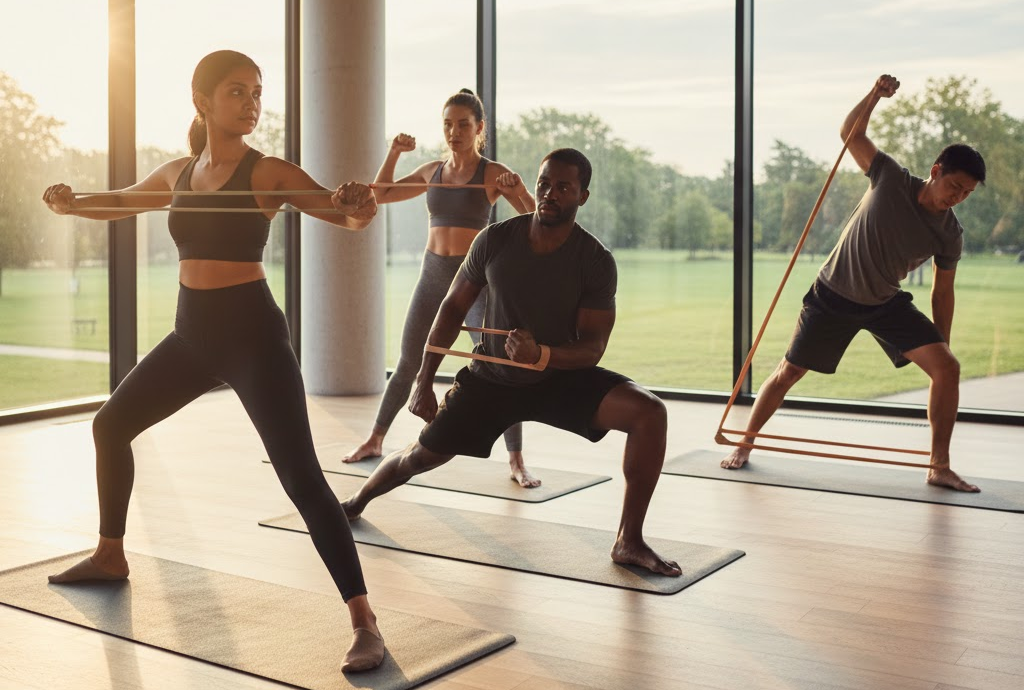
Balance is a core pillar of yoga, and it starts with strong legs and stable ankles. Doing workouts with resistance bands for legs can take your standing poses to a new level. Placing a loop band above your knees during “Warrior II” or “Chair Pose” makes your hip muscles work harder. This helps keep your knees from moving inward.
So, how to gain strength in legs?
The answer is simple. This is a key tip for anyone wanting to build leg strength while staying flexible. Resistance training helps strengthen the small muscles around your hip joint. This makes your yoga poses look easier and improves your walking and running form. It creates a strong base that supports your entire skeleton.
Master Resistance Training at Home
One of the best things about this equipment is how easily it fits into a busy lifestyle. If you want to learn how to use resistance bands at home, you only need a small clear space and a flat floor. Bands are easy to store. You can put them in a drawer or a travel bag so that you won’t miss a workout.
For beginners, the essential factor is learning how to use exercise bands with control. It is not just about how much you can stretch the rubber band, but about how well you can handle its pull as it returns. This part of the movement, called the “eccentric” phase, is where most of the strength gains happen.
Using resistance bands at home is an affordable method to build a professional-level fitness routine without needing a gym membership.
| Band Type | Best For | Typical Exercises |
| Light Loop Band | Yoga Activation | Clamshells, Lateral Walks |
| Medium Therapy Band | Pilates & Posture | Seated Rows, Shoulder Flossing |
| Heavy Power Band | Muscle Mass | Resisted Squats, Chest Press |
| Long Tube Band | Full Body Flow | Banded Woodchoppers, Lunges |
Follow Your Daily Ten Minute Flow Routine
You can start enjoying the benefits today with its easy sequence. Try to perform these movements slowly and breathe deeply in a regular rhythm.
- Resisted Bridge: Place a loop band above your knees. Lift your hips into a bridge position while pushing your knees outward against the band. Hold for five breaths.
- Banded Archer: Stand up straight and hold a long band in both hands. Pull the band back like you’re drawing a bowstring while keeping your other arm straight. This exercise strengthens your upper back and rear shoulders.
- Lateral Leg Lifts: Lie on your side with a band around your ankles. Lift your top leg to work on hip stability and strengthen your side glutes.
- Standing Chest Expansion: Hold the band behind and pull it outward while just opening your chest. This helps correct the hunched posture that comes from sitting at a computer.
Conclusion
Adding resistance to your movement can help you get more out of every minute on the mat. When you combine yoga’s focus with the physical challenge of elastic bands, you support your spine, build lean muscle, and improve your overall strength. These bands are affordable, easy to carry, and work for all fitness levels.
Whether you are a seasoned Pilates expert or a beginner trying to tone up at home, bands offer great versatility. Start by adding one or two resisted movements to your next routine and notice the improvement in your stability and strength. Your body will simply appreciate the extra support and challenge.
If you are ready to take your training to the next level, explore our practical guide for the best workout machine to help you define your core and boost your metabolic rate.