Most gym equipment ends up as an expensive clothes horse within six months. Late-night infomercials frequently promise Greek god abdominal definition through vibrating belts, complex seated machines, or miracle supplements that rarely deliver. Yet, tucked away in the corner of every serious performance gym is a simple, silent, and incredibly inexpensive tool that puts them all to shame: the ab roller.
At Supfit, the focus is always on functional efficiency rather than flashy trends. Whether the goal is building a resilient body for everyday life or simply maximising a daily workout routine, the core remains the literal powerhouse of the body. Here is why this humble wheel remains the undisputed king of midsection training and why it should be the cornerstone of your home gym setup.
Beyond the Crunch: The Science of Tension
The most common mistake in modern core training is an over reliance on the traditional crunch. While crunches target the superficial six pack muscles, they do very little for functional stability or athletic power. An abdominal wheel workout operates on a completely different principle known as anti-extension.
As the wheel moves away from the body, gravity acts as a powerful lever, trying to force the lower back to arch and the pelvis to tilt. To counter this, the core muscles, specifically the rectus abdominis and the deep transverse abdominis, must fire with immense force to keep the spine neutral. This effectiveness is backed by significant data. As highlighted in research shared by Runner’s World UK, the rollout is consistently ranked as one of the most effective movements for eliciting high levels of muscle activity. By forcing the muscles to work while elongated, you create a level of structural strength that crunching movements simply cannot replicate.
Are Ab Rollers Effective for All Fitness Levels?
A frequent concern for those starting a new fitness regime is whether the tool is too advanced. People often ask, “are ab rollers effective for beginners, or will they just cause a back injury?”
The beauty of the ab wheel roller workout lies in its inherent scalability. It is an adjustable exercise that does not require you to touch a single weight stack or pin. By simply limiting the distance of the roll, the intensity is managed. A beginner might only roll forward twelve inches, whereas an elite athlete might roll until their nose touches the floor. Over time, as the bracing strength improves, the range of motion naturally increases. This builds a level of pillar strength that translates directly into better posture, reduced back pain, and improved injury prevention in everyday life.
How to Use a Roller for Abs: The Masterclass
Success with exercise wheel workouts is dictated entirely by form. Moving from point A to point B is easy; moving while maintaining total spinal integrity is the real challenge. If the lower back arches, the tension leaves the abs and enters the spine, which is exactly what we want to avoid. Follow this step by step guide to master the movement:
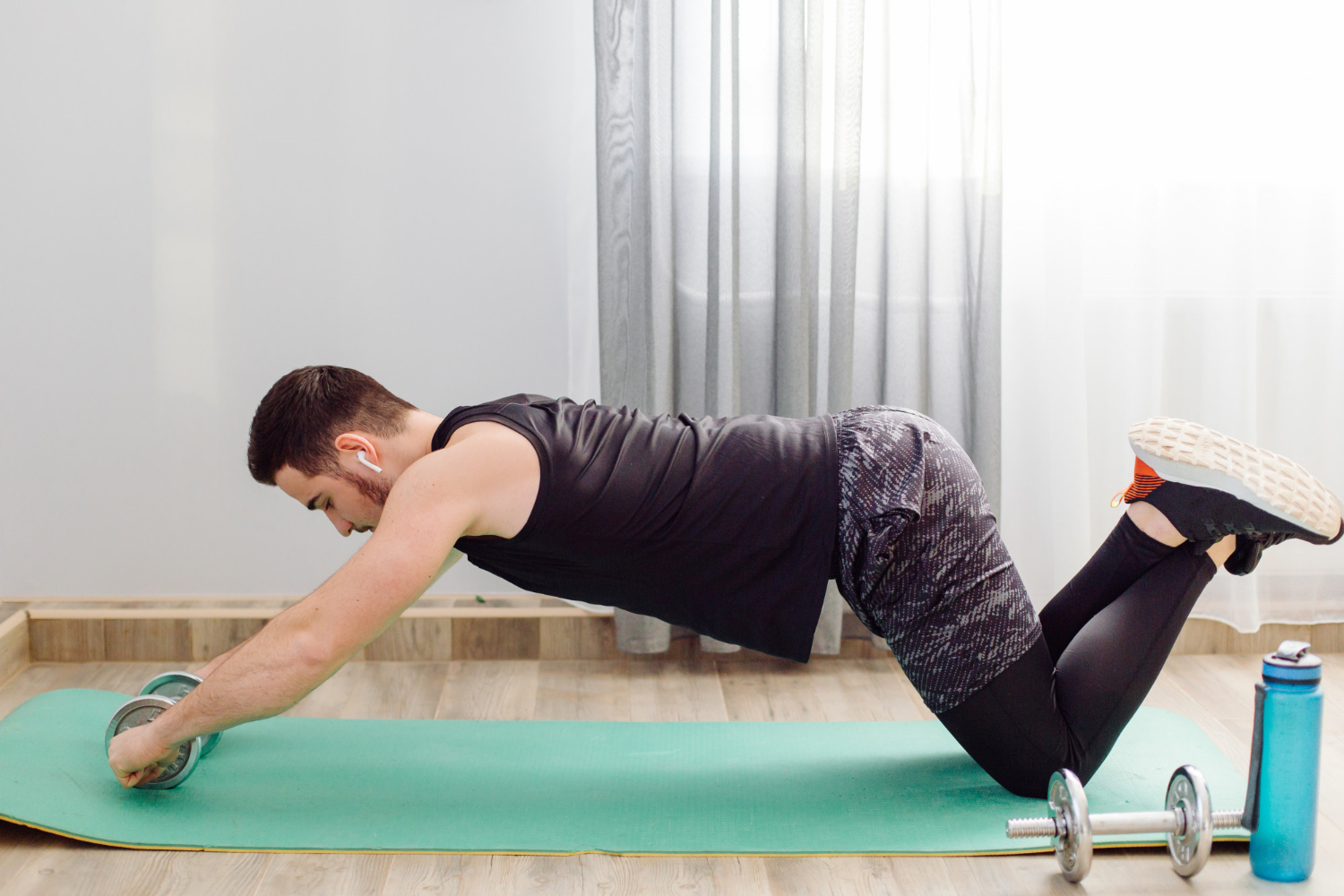
- The Starting Position: Kneel on a comfortable, non-slip surface to provide the necessary knee support needed to prevent discomfort.
- Set the Pelvis: This is the most important step in the entire process. Tuck the tailbone under (known as a posterior pelvic tilt) and squeeze the glutes tight. The back should have a slight, natural outward curve, never a dip.
- The Controlled Roll: Grasp the handles of the Ab Roller and slowly push forward. Inhale as you descend and keep your arms straight but not locked.
- Find the Sweet Spot: Stop just before the point where you feel your lower back might start to arch. For a complete novice, this might only be a very small movement.
- The Contraction: Imagine you are trying to crunch the floor toward your knees. Use the stomach muscles to pull the wheel back to the start. Do not lead with the hips or sit back on your heels; keep the tension on the midsection throughout the entire repetition.
Aim for 3 sets of 5 to 10 repetitions. Quality is infinitely more important than quantity here. If your form breaks even slightly, the set is over.
Selecting Professional Grade Gear
Not all wheels are created equal. Many high street versions are narrow, flimsy, and unstable, which forces the user to focus on balancing rather than contracting the muscles. When performing exercises using ab roller kits, stability is the most important factor for safety.
Choosing a wider wheel, such as the one found in the Entersports Ab Rollers Wheel Kit, provides a much broader base of support. This allows for a deeper focus on the eccentric (lowering) phase of the movement, which is where the most muscle growth and strength gains occur. Furthermore, a high quality kit often includes knee pads and resistance bands to help beginners bridge the gap toward full extensions. Look for stainless steel internals and non slip rubber treads to ensure the tool lasts as long as the results do.
The Role of the Core in Overall Performance
It is worth noting that a strong core is about more than just aesthetics. As discussed in our guide on seven ways to improve athletic performance, the core acts as the bridge for power transfer between the upper and lower body. Whether you are swinging a golf club, running a marathon, or simply lifting groceries, a stable midsection ensures that energy is not leaked through a weak spine. The ab roller is perhaps the most direct way to train this specific type of bracing power.
The Final Word
The ab roller has outlasted decades of fitness fads because it respects the mechanics of the human body. It demands discipline, rewards consistency, and requires almost no floor space. It is a tool of pure utility.
For anyone serious about building a core that is as strong as it looks, it is time to stop looking for shortcuts. Embrace the wheel, master the roll, and build a foundation that supports every other athletic endeavour you choose to pursue.